Now I love a good chicken hut; drool over them; dream about what I could put in them and relish in its construction and amenities - ventilation, nesting boxes, perches, runs etc, (sad I know), but I was shocked to see the sheer vast array on offer these days.
In the current (September) edition of Country Smallholding magazine, Poultry section there is a feature on housing. The diversity of houses from construction firms is phenomenal. Construction materials include a rigid hard plastic; one made from something described as non-absorbent materials; 100% UK recycled plastic; but the majority are still made from (my favourite) treated timber. There's something about a well constructed chicken hut made from wood and stained a dark colour that really get's me excited (little things, I know!).
In the magazine there are over a dozen companies advertising their huts, the styles and designs are many and varied. Which got me to thinking (Oh no, I hear you groan!), what are the essentials for chickens welfare in housing? I looked up the Poultry Club of Great Britain's website, they being the doyenne of all things poultry and came up with the following -
1. Ventilation - adequate enough to stop the build up of condensation and therefore bacteria and should be located towards the top of the house to ensure the birds have no draughts coming up from underneath.
2. Window - usually covered in mesh, glass is not safe, it can break. The window is to assist with egg laying, letting more light in; the lengthening daylight hours increase egg production.
3. Space per bird - Large birds need 30sq cm each, bantams a little less (doesn't seem very much to me, but I suppose that's the minimum). If you suffer from really bad weather it would be best to allow them more, especially if they use it to shelter from the weather.
4. Perches - ideally 5cm wide with rounded edges (also see the above edition of Country Smallholding magazine, there is an excellent article on a trial done on perches, makes for interesting reading).
5. Pophole - this is the chickens access door. Complete with an actual door which is closable at night for security purposes. I notice in some Chicken magazines that there are adverts for door timers these days too - the height of laziness!
6. Some larger form of door / take out panel for ease of cleaning the hut.
7. Nest boxes - should be located at the darkest and therefore the lowest part of the house. They usually look like an add on, onto the side of the house. Each box should be up to 30sq cm, and one box will service every four hens. I do find that most of my hens tend to prefer only one or two of the boxes, the others used for sleeping in!
Tomorrow I will look at runs, bedding, different styles of hut etc - watch this space!
Be interested to see/hear of your views on these designs, especially the new style ones.
Stats today -
Eggs produced = 11
Sales -
1 dozen eggs
Expenses -
Nil
Monday, 12 August 2013

Saturday, 10 August 2013
Good old eBay!
Thanks to eBay and Rob from Tiptree in Essex, and to his wife for the coffee, drinks and chocolate biscuits (says Michael), I am now the proud owner of a fabulous new greenhouse and five cold frames.

Michael and Rob spent the afternoon dismantling the approx 6m x 2.4m aluminium greenhouse. I've now got to decide what to grow for sale next year.
The deconstruction process -


Michael would like to extend a huge thank you to Rob for helping him take it down, he was extremely helpful.
Can't wait for next year now, it's going to be a huge task to get it up, the base laid, staging in and the cold frames erected too, but it'll be well worth it.
Stats today -
Eggs produced = 10
Sales -
1/2 dozen eggs £0.90
1 x 500g Carrots £0.75
1 x Cucumber £0.60
Expenses -
Greenhouse and cold frames £383.00 (that's an awful lot of eggs and veg to sell!)

Michael and Rob spent the afternoon dismantling the approx 6m x 2.4m aluminium greenhouse. I've now got to decide what to grow for sale next year.
The deconstruction process -

Glass out from the sides

Roof off

Loaded and ready to come home
Michael would like to extend a huge thank you to Rob for helping him take it down, he was extremely helpful.
Can't wait for next year now, it's going to be a huge task to get it up, the base laid, staging in and the cold frames erected too, but it'll be well worth it.
Stats today -
Eggs produced = 10
Sales -
1/2 dozen eggs £0.90
1 x 500g Carrots £0.75
1 x Cucumber £0.60
Expenses -
Greenhouse and cold frames £383.00 (that's an awful lot of eggs and veg to sell!)
Friday, 9 August 2013
Fruit, fruit everywhere and all of it to eat!
Now I love fruit, all of it, could live on it I reckon, so when we moved in here, it was with great joy that I noticed several mature fruit trees. I never get bored of apple pies, crumbles, tarts, or the same with plums.
Now the plums look stunning this year, the two Victoria plum trees are loaded with fruit. Last year was a different matter, nothing at all, not one fruit did we get, the awful spring annihilated all the blossom. So apart from the fruit on the lower branches that the dogs jump up and pinch, we should have a bumper crop this year.


Pear trees are laden as well this year. We have two trees here, one is a Conference tree and the other has Conference pears but another type on it aswell, must have been grafted onto it.


I assure you these are on the same tree!

Purple plums

These are the Bramleys, the cookers, two huge trees we have which are again laden with fruit this year, again the dog's pinch the ones they can, and then get sickly tummies for doing so, but there are always so many on the trees, we have more than we need. Plenty get put in the freezer to eat all year round and then some will get sold this year.
The other tree we have is an eating apple. I have no idea which variety it is other than it's a russet apple. They are delicious if you like a good hard, tart apple. There doesn't seem to be many on the tree this year which is a shame, but hey, you can't have everything.

The eaters!
The other fruit we have is raspberries, which have finished now; I did put six kilo's in the freezer, of which most I will jam. We also put in 100 strawberry plants this year, but didn't let them fruit, just let the plants build up their strength, to hopefully produce lots of lovely strawb's next year - can't wait!
What types of fruit do you grow, and which do you find most successful? I'd be interested to hear, especially on top fruit, as this is something we haven't ventured into yet.
Stats today -
Eggs produced = 7
Sales -
1/2 dozen eggs £0.90
1 x Cucumber £0.60
1 x 250g Tomatoes £1.00
Expenses -
Nil
Thursday, 8 August 2013
Look what they've done now!
The little blighters, not content with decimating my winter cabbages they've been on my spring cabbages aswell.


That's two trays nearly all eaten. It was only by chance that I noticed them. I was watering them yesterday and wondered what was going on, happened to take a closer look and noticed what looked like caterpillar poo on the leaves, near where the leaves joined the stems on the upper surface, and didn't believe my eyes.
I swept my hand gently across the top of them and lo and behold did the little blighters fall off onto the compost in front of my eyes! So I did it again until I found them all, and took great delight in squashing them. I'm hoping they aren't too far gone and will re-grow. I had planned to plant two more trays, as we can sell them once pricked out and plant some here to for sale next year; looks like that job has just been added to my list for tomorrow. Oh well that's gardening for you.
Stats today -
Eggs produced = 11
Sales -
1 & 1/2 dozen eggs £2.50
1 x 500g Tomatoes £2.00
1 x 500g Carrots £0.75
2 x Geranium plants £3.00
Expenses -
Nil
Wednesday, 7 August 2013
BASIL! No, it's not just become Faulty Towers
Now I love Basil - the herb; everything about it, the smell, taste, what you can use it in. Maybe it's my love of Italian food - pizza's, pasta, tomatoes; see my earlier blog post with my tomato sauce recipe, just rip up a handful of leaves and throw them in. So I decided to find out a bit more about it.
Ocimum basilicum to give it its latin name comes in several colours, from yellowish green, through green to purple, all of which produce white flowers in summer.

I pinched an idea from Monty Don of Gardeners World fame, who says he always plants his next to his tomatoes in the greenhouse, and I have done the same this year. Plus I have just read, and I am quoting here from 'Growing Herbs', by Murdoch books; 'Basil is a popular companion plant with organic gardeners, who believe that planting it next to tomatoes and capsicum will improve their growth.' So I guess Monty does know a thing or two after all!

The leaves are covered in small oil cells which gives the herb its strong flavour and aromatic smell and the flowers should be pinched out to preserve the smell. It is an annual plant, that I find is best sown fresh every spring in a greenhouse. It can be taken outside in warm summer, but I tend plant mine in the polytunnel or keep it in a pot on the kitchen windowsill.
Many myths and legends surround this wonderful herb; from being loved or truly hated; it has a link to scorpions of all things and was thought to be able to turn itself into one (!); and to tales that only beautiful women could cultivate it (obviously that's rubbish because Monty grows it so well!); it is classed as a Holy plant in its native country - India, being grown outside temples, laid on the chests of dead Hindu people, and used as a disinfectant and insect repellant.
It also has medicinal properties; being a useful soothant of travel sickness, or general stomach complaints, (make a tea from the leaves).
The most well known use is of course Pesto, made from your own leaves -
100g Fresh basil leaves
1 tbsp toasted pine nuts
75g Parmesan cheese
6 tbsps Good olive oil
2 large cloves of garlic
Salt and pepper to taste
Blend the basil, garlic and pine nuts to a pulp, either in a pestle and mortar or a liquidiser.
Alternately add a tablespoon of oil and then a tablespoon of cheese until it is blended together.
Season with salt and pepper to your liking.
Serve through hot pasta, with salad from your garden, including lots of tomatoes. Yum!
Stats today -
Eggs produced = 11
Sales -
1 dozen tomatoes £1.80
1 x Mint herb plant £0.50
Expenses -
Nil
Ocimum basilicum to give it its latin name comes in several colours, from yellowish green, through green to purple, all of which produce white flowers in summer.

Gorgeous flowers on the purple variety
I pinched an idea from Monty Don of Gardeners World fame, who says he always plants his next to his tomatoes in the greenhouse, and I have done the same this year. Plus I have just read, and I am quoting here from 'Growing Herbs', by Murdoch books; 'Basil is a popular companion plant with organic gardeners, who believe that planting it next to tomatoes and capsicum will improve their growth.' So I guess Monty does know a thing or two after all!

I've just measured this one, the biggest one in the polytunnel and it stands 77cm tall!
The leaves are covered in small oil cells which gives the herb its strong flavour and aromatic smell and the flowers should be pinched out to preserve the smell. It is an annual plant, that I find is best sown fresh every spring in a greenhouse. It can be taken outside in warm summer, but I tend plant mine in the polytunnel or keep it in a pot on the kitchen windowsill.
Many myths and legends surround this wonderful herb; from being loved or truly hated; it has a link to scorpions of all things and was thought to be able to turn itself into one (!); and to tales that only beautiful women could cultivate it (obviously that's rubbish because Monty grows it so well!); it is classed as a Holy plant in its native country - India, being grown outside temples, laid on the chests of dead Hindu people, and used as a disinfectant and insect repellant.
It also has medicinal properties; being a useful soothant of travel sickness, or general stomach complaints, (make a tea from the leaves).
The most well known use is of course Pesto, made from your own leaves -
100g Fresh basil leaves
1 tbsp toasted pine nuts
75g Parmesan cheese
6 tbsps Good olive oil
2 large cloves of garlic
Salt and pepper to taste
Blend the basil, garlic and pine nuts to a pulp, either in a pestle and mortar or a liquidiser.
Alternately add a tablespoon of oil and then a tablespoon of cheese until it is blended together.
Season with salt and pepper to your liking.
Serve through hot pasta, with salad from your garden, including lots of tomatoes. Yum!
Stats today -
Eggs produced = 11
Sales -
1 dozen tomatoes £1.80
1 x Mint herb plant £0.50
Expenses -
Nil
Tuesday, 6 August 2013
Interview with a Smallholder
I
met Mik and Gill Bedson in their warm and cosy kitchen at Chapel Farm, Suffolk,
over coffee and biscuits to chat to them about their lifestyle. I wondered if they had any links to farming
or smallholding. The answer to that
question was ‘No’, only Dads who grew vegetables. Their passion came from wanting a better life. They weren’t happy with the way food was
being produced in this country – mass produced, factory farmed, with seasonality
disappearing altogether.

Mik & Gill Bedson
Roll
back the clock to 2004, Mik and Gill are living in a small village, near
Leighton Buzzard in Hertfordshire, both are commuting to London, five days a
week. Mik is working for a telecoms
company and Gill, a health company. In
the small back garden of their country cottage are some hens, home grown vegetables
and the occasional two weaners, ownership being shared with friends.
Mik
is then given an opportunity of a lifetime, to go and work India, so Gill
resigned and off they went. As she had
no need to work, plus household servants, Gill developed a passion for Art. This passion for Art stays with her after three
and a half years in India, when they decided to come back to the UK. On their son’s advice they moved to Suffolk,
because it’s a ‘nice’ county, close to their children and still within
commutable distance to London for Mik’s work.
Gill decided not to go back to work, to concentrate on smallholding and developing
her art. I asked them if it was a joint
decision to smallhold. They both agreed
it was, although slightly more biased towards Gill as Mik was working full time.
Chapel
Farm was purchased in 2008. Five and a
half acres of gently sloping grassland, a large veg plot and fruit trees, a
small orchard, plus various outbuildings for storage and a workshop. Weaner pigs were purchased then a few
sheep. The pig enterprise was then expanded
to include two Oxford Sandy & Black gilts for breeding. Then the jobs started; the whole site needed
stock fencing, the veg plot digging over, animal shelters constructing and
copious amounts of equipment purchasing, all whilst Mik was still working in
London.

The mixed flock of sheep and variety of chickens
Then
came the blow, Mik was made redundant and they had spent up. So another big decision had to be made – what
to do? Should Mik go and get another
job? Or were they both committed enough
to smallholding to make a go of it and become self sufficient as far as they
could, and live off a smaller income?
Suffice to say, he gave up work!
Roll
the clock forward, Gill is pursuing her Art career, Mik is working part time
for a community project, based around producing local food, and they manage the
smallholding between them. Extra income
is earned through selling their surplus meat and livestock. All their garden produce is eaten fresh or frozen
for leaner times. They produce their own
milk and cheese, courtesy of their small herd of pedigree English goats. Pork, bacon and sausages are produced from Saddleback
or Oxford, Sandy and Black pigs. Lamb
and mutton are produced from their mixed flock of sheep – Leicester Longwools,
Lleyns and Jacobs. Varying breeds of
hens produce a good supply of eggs, meat chickens are produced for the freezer
and about half a dozen Norfolk Black Turkeys are fattened for friends and
family at Christmas. All of their livestock
are rare breeds, they produce wonderfully flavoured meat. Gill uses them for inspiration for her art
work, ‘because they are pretty to look at’, she says.

Old English milking goats


Saddleback sow (Blossom) and her piglets
They
have had their ups and downs, it has not all been plain sailing. The first lambing was a baptism of fire,
truly awful, Gill recollects. All four
ewes had difficult births, multiple lambs, some lambs not feeding; twelve lambs
from four ewes, a lambing never to be forgotten. Having got used to a very lucrative lifestyle
when Mik was earning, one of the worst things to get used to was learning to
live on less money. Lack of knowledge
was never a problem, with the internet, books and always someone who knows more
than you. The emotional side of dealing
with dead livestock is something that you never really get used to, they
say. Livestock you have nurtured over
the years, ones you have brought into the world, there is nothing you can do
when they die – heartbreaking. Another downside they both agree on is the winter
weather; rain, snow, wind; the cold is just foul and then there’s the mud, ‘Say
no more’, says Gill. Being tied to the
smallholding Gill finds difficult sometimes, you can’t just up and leave when
you have livestock to consider; their children don’t always appreciate this when
one of them has a crisis that needs mum or dad’s attention.
The
best bits for them are numerous; not
having to get up and go to work for someone else; the flexibility of life;
attending to jobs as they arise e.g. catching loose sheep; learning new skills,
Mik says, building lambing sheds, dealing with livestock problems, medical or
otherwise, he reckons it keeps him young.
In essence they feel they are time rich, cash poor. I also asked them if there was anything they
missed from their ‘old life’. Mik likes
his gadgets and due to the lack of spare cash, he’s upset that he can’t have
the latest iPad, but certainly doesn’t miss the commute or the job. Gill misses the thrill of helping people
through her nursing, but volunteering for CRUSE helps with this. Another question was if they were to start
again at Chapel Farm would they do anything different? Mik would’ve loved to have put in some sort
of water collecting device, either sinking a tank or borehole, it’s all
hosepipes, which is a nightmare when it freezes; field standpipes would have
been a better idea. Essentially they
would’ve liked to have been more ecologically friendly all round, with a wind
turbine, solar panels and a solid fuel heating system preferably, unfortunately
lack of money put a stop to this.
Then
the ultimate question – Do they make a living from smallholding? The basic answer is, ‘No’. Essentially their
smallholding income comes from selling eggs, meat and young livestock. Selling the surplus covers the cost of
growing the animals in the first place, plus the cost of slaughter and
butchering. This allows them to eat what
they want for free. Mik found the
economies of scale quite difficult, too many pigs were not cost effective;
there is no market for that amount of meat at their level.
I
reach the end of my interview with them gaining a real sense of satisfaction
from Mik and Gill, they are happy with their life and their lot, not wanting to
change much at all. Two more satisfied
smallholders; this life really is a joy.

Proudly surveying his charges, on a wet breezy day
Stats today -
Eggs produced = 12
Sales -
1 x 250g Tomatoes £1.00
1 x Cucumber £0.60
1/2 dozen eggs £0.90
Expenses -
Nil
Monday, 5 August 2013
Mysterious theft
We seem to have suffered a small spate of thefts here on the smallholding.


Now I love sweetcorn, it's one of my favourite crops in the veg patch. Get the water boiling on the stove then go and pick a cob or two, drop it straight into boiling water, then eat with lashings of salted butter, until it drips down your chin, ~Yummy!
So I was rather annoyed to say the least to find this had happened. It's a patch of land next to the fence, behind the raspberries and next to the muck heap, that I thought would be perfect for the sweetcorn, a patch out of the way where they could grow and not bother anyone. It seems that something has bothered it though. My husband didn't know anything about it; it wasn't rabbit damage, so it was quite puzzling for a while.
Until ..... Somebody came to say hello over the fence when I was in the veg patch


What is she like! That'll teach me I suppose.
Stats today -
Eggs produced = 10
Sales - (excellent day today!)
1/2 dozen eggs £0.90
1 x Cucumber £0.60
3 x 250g Tomatoes £3.00
2 x Geranium plants £3.00
Expenses -
Nil
Sunday, 4 August 2013
Norfolk Smallholder show
Just had a fabulous day out at the Norfolk Smallholders show held at Sheringham Park, Norfolk. A great day out for all the family.
I love this show because it's never too big, there's plenty going on, plenty of places to sit, plenty of stalls to wander around and most importantly plenty of choice of food stalls.
I had an excellent hog roast from the hard working people at Oak Tree Farm, their home grown, rare breed pork is just divine. The 'cafe' tent was great value at £1 for a cuppa and £1 for a piece of homemade cake with a choice of five. I even brought home some scrummy homemade fudge, which was devoured within minutes.
The vast array of stallholders was diverse, but all linked in their cottage industry style; blacksmiths, wood carvers, fleece's for sale, poultry for sale, numerous plant stalls, even Home farmer magazine came over to join us (one of my favourites); many of them rebooked for next year already.
Question and answer sessions were scheduled for twice throughout the day, the resident vet being on site, plus Norfolk Smallholder committee members available for members of the public to ask any sort of questions they like, be it animal, vegetable or even mineral!
Animals were well represented. A poultry stand with assorted breeds for which the public could vote for their favourite. Goats, both meat and dairy varieties were in attendance, heavy horses, alpacas, a fine looking jacob ram, turkeys and ducks were all available for the public to approach, ask questions and generally learn about; their owners proud to be showing off their specimens.
A few photo's of the day -

The impressive bread stall

For the sheep shearing demonstration

Norfolk black turkeys

British Toggenburg nanny

British Alpine kids

The fun dog show

Blacksmiths forge stallholder

Chainsaw wood carving

The Fabulous Fleece company stall

Poland chickens

A fine Jacob ram

Boer goat kids

A British Alpine nanny

Alpaca walking!
The overall opinion of the Norfolk Smallholders committee was one of delight; approximately 2500 people came through the gates, going home with excited but tired children having had a fun day; approximately 50 new members were signed up with a few more taking membership forms home. Bernard Ashe - press officer, said - 'most people said what a nice, friendly, enjoyable show it was, not huge but children could still wander without getting lost. All in all the committee is very happy.'
Saturday, 3 August 2013
Peppers V Peppers
The battle of the Peppers!
Now, I've always been told that you cannot grow Peppers and Chilli peppers in the same greenhouse / polytunnel at the same time, because they are too closely related and will not produce fruit if you do.
That sounded like a challenge to me, and always up for a challenge, I decided to see, more out of curiosity than anything, what would happen if you did plant the two plants side by side.

Sweet Peppers


Chilli Peppers
These two plants are less than half a metre away from each other and seem to be thriving, (that's the same yellow leaf of a cucumber plant in the photo's).
Having read several books on the subject of growing peppers and chillies, I find that nowhere in these books does it say that you cannot grow them together, in fact they are both in the same family as tomatoes, potatoes and aubergines and should be treated as such for rotation purposes. Both are reasonably easy to grow, suffer from little problems - the usual slugs, aphids and red spider mite; the main problem being blossom end rot, ie. lack of sufficient water, but if you're seeing that on peppers then you'll be seeing it on your tomatoes too and bells should start ringing in your head to give them all more water.
So I shall continue to plant all my peppers and chillies together and not listen to other people's ideas until I have thoroughly checked them out. To think I had been panicking about not getting any peppers or chillies - that'll learn me, as they say here in Norfolk!
Stats today -
Eggs produced = 12
Sales -
1 dozen eggs £1.80
1 x 500g Carrots £0.75
1 x Oregano plant £0.50
Expenses -
Nil
Friday, 2 August 2013
My easy bread recipe
Now this is a simple recipe that you can adjust/adapt to suit your needs - add cheese, herbs, fruit, veg etc. It's the one I use all the time. If it doesn't turn out quite how you want the first time, just keep at it, it gets easier the more you do it.
This basic mix makes one small loaf or six rolls -
1/2 tsp Salt
300g Bread flour - white, wholemeal, granary or a mixture of the three
300ml Warm water
1 tsp Dried yeast - I tend to buy the resealable 125g tubs of dried yeast, because I don't use the whole sachet if buying boxes of sachets; it's also cheaper.
Place the salt in the bottom of a large mixing bowl, tip the flour on top, scatter yeast over the flour and pour in the water.


Mix all the ingredients together well to incorporate all the flour, a fair amount can get left at the bottom of the bowl. At this stage it will be sticky, but don't worry, this results in a softer loaf, I find.


Put plenty of flour onto your work-surface and on your hands then tip out the mixture onto the work-surface, scraping out as much of the dough as possible.


Add more flour as it gets sticky, the flour will become incorporated into the dough as you knead.

Keep kneading until the dough becomes stiff, usually takes between 5 - 10 minutes.


Four and a half hours later, mine looked like this -


This basic mix makes one small loaf or six rolls -
1/2 tsp Salt
300g Bread flour - white, wholemeal, granary or a mixture of the three
300ml Warm water
1 tsp Dried yeast - I tend to buy the resealable 125g tubs of dried yeast, because I don't use the whole sachet if buying boxes of sachets; it's also cheaper.
Place the salt in the bottom of a large mixing bowl, tip the flour on top, scatter yeast over the flour and pour in the water.

All the ingredients in. This is a double, i.e. 600g flour, 600ml water etc, and a mixture of wholemeal and granary - I was using up bags of flour

All the ingredients added - white flour
Mix all the ingredients together well to incorporate all the flour, a fair amount can get left at the bottom of the bowl. At this stage it will be sticky, but don't worry, this results in a softer loaf, I find.

Brown mix

White mix
Put plenty of flour onto your work-surface and on your hands then tip out the mixture onto the work-surface, scraping out as much of the dough as possible.


Now for the kneading! Don't hold back, you can use them muscles. Start pushing, pulling and stretching the dough, after each stretch give the dough a quarter turn.


Keep kneading until the dough becomes stiff, usually takes between 5 - 10 minutes.

The kneading finished
Place the dough back in the same bowl you mixed it in, cover it with cling film and leave it aside, to rest and rise in a warm room for a couple of hours at least; even better, leave it overnight in the fridge.


Brown flour dough

White flour dough
Notice all the bubbles - that's normal.
Give the bowl a bang on the work-surface, watch the dough as it should sink quickly.
Tip the dough out onto a well floured surface and divide with a blunt knife into six for rolls or leave whole for a loaf. Shape the dough. If making a loaf, shape into an elongated shape and drop into a greased loaf tin. If making rolls, shape each roll and place on a greased baking sheet.

White rolls

Brown rolls
Leave them for about an hour, or until they have doubled in size, this is the second rising. Preheat your oven to 180 Degrees centigrade / Gas mark 4.
Once they had doubled in size,
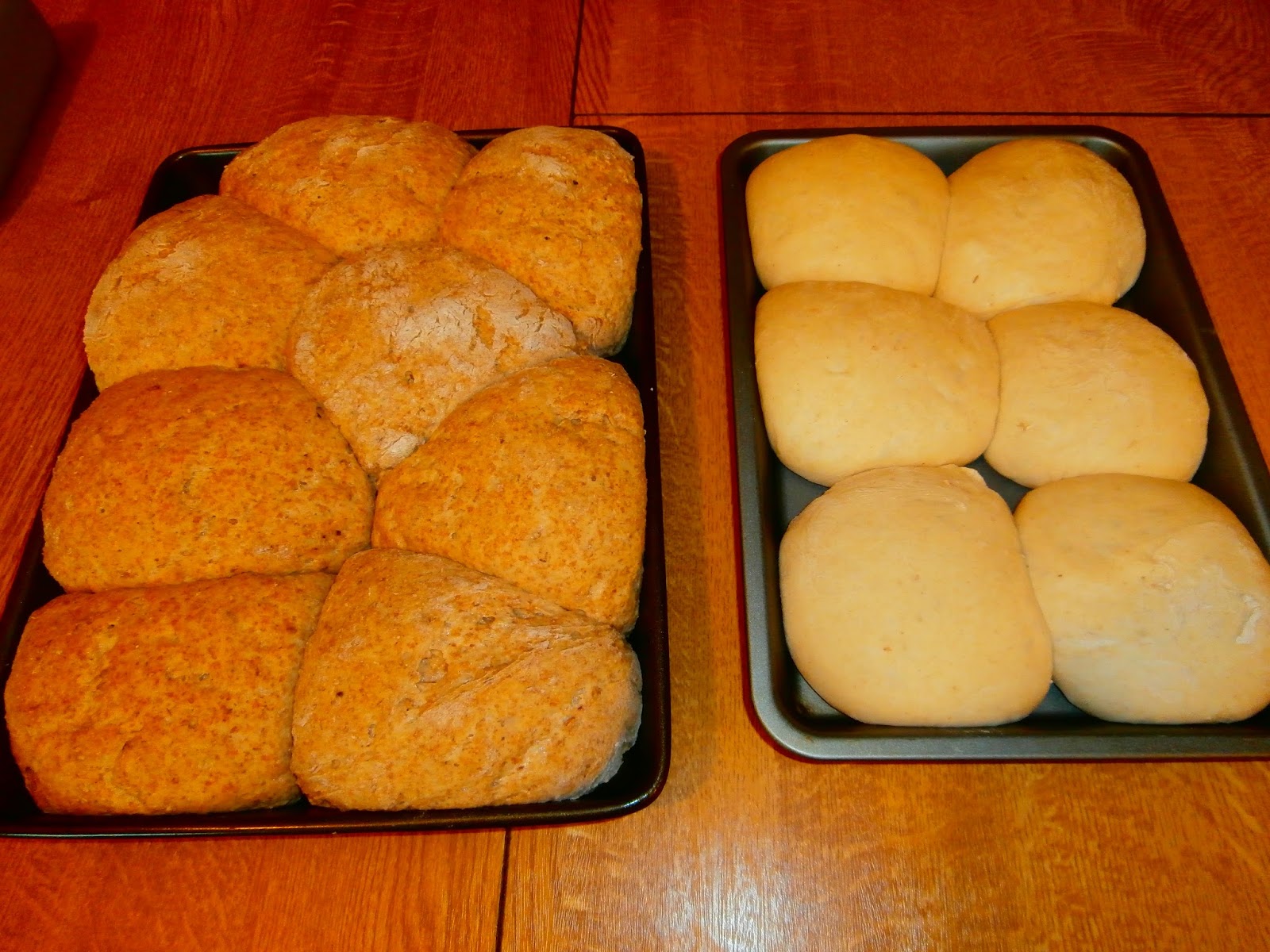
bake in the oven for between 20 - 30 minutes (loaves take nearer the 30 minutes), until crisp on top and sound hollow when tapped on the bottom. I tend to take them out of their tins and put them back in the oven for about five minutes to crisp up the bottoms. Once cooked transfer them to a wire rack to cool. Once cool they can be frozen.


The finished rolls, top pic shows the crumb
They are rustic, but better for you than that stuff they sell in the supermarkets without all the preservatives in them. They make fab toast, with lashings of butter and jam!
TIP -
When washing up the dough bowl and utensils, rinse everything in cold water first, using your fingers to dislodge the dough remnants , then wash as normal. Otherwise the hot water starts to cook the dough and it sticks to EVERYTHING!
Stats today -
Eggs produced = 12
Sales -
1 dozen eggs £1.80
1 x Geranium plant £1.50
1 x Cucumber £0.60
Expenses -
Nil
Subscribe to:
Posts (Atom)